MAFAC's cleaning results impress in fluorescence testing
F-Scan makes MAFAC's cleaning results visible.
Technical integrity requires objective evidence
When technical cleanliness is critical to functionality, process reliability, and validation, it is not enough to consider the cleaning process alone. Objective, reproducible evidence is needed to confirm whether a component actually meets the required cleanliness standards. Similarly, before integrating components into highly sensitive process chains, it must be objectively verified whether components from suppliers meet quality requirements or need to undergo additional cleaning.
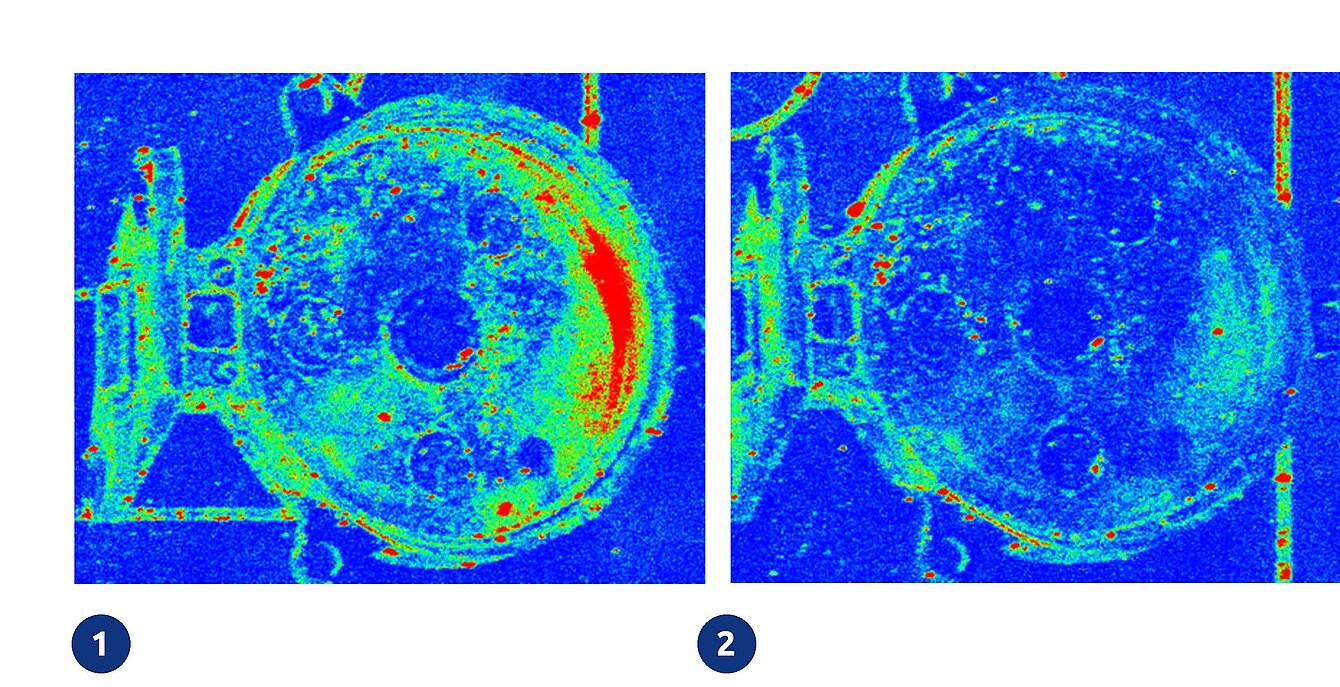
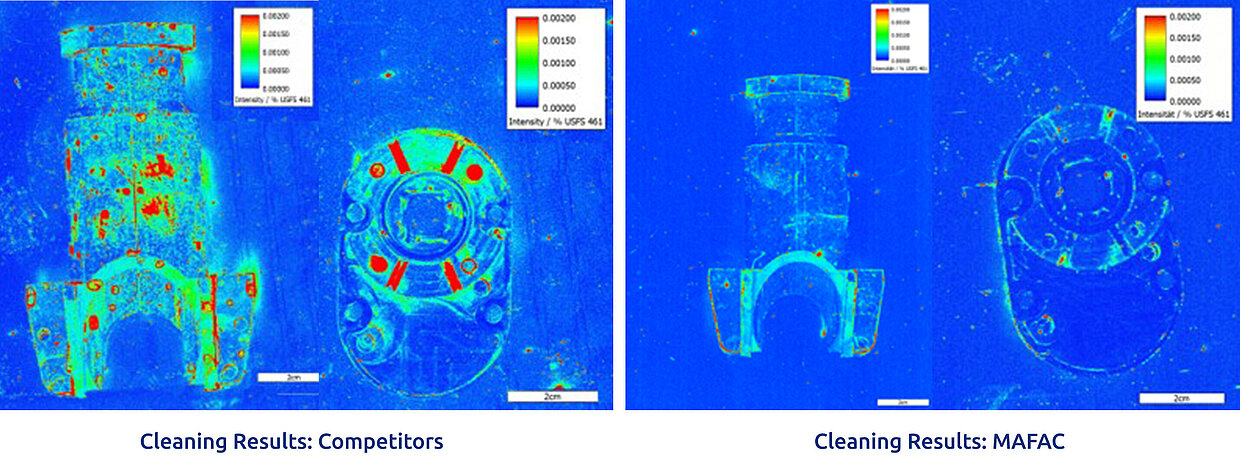
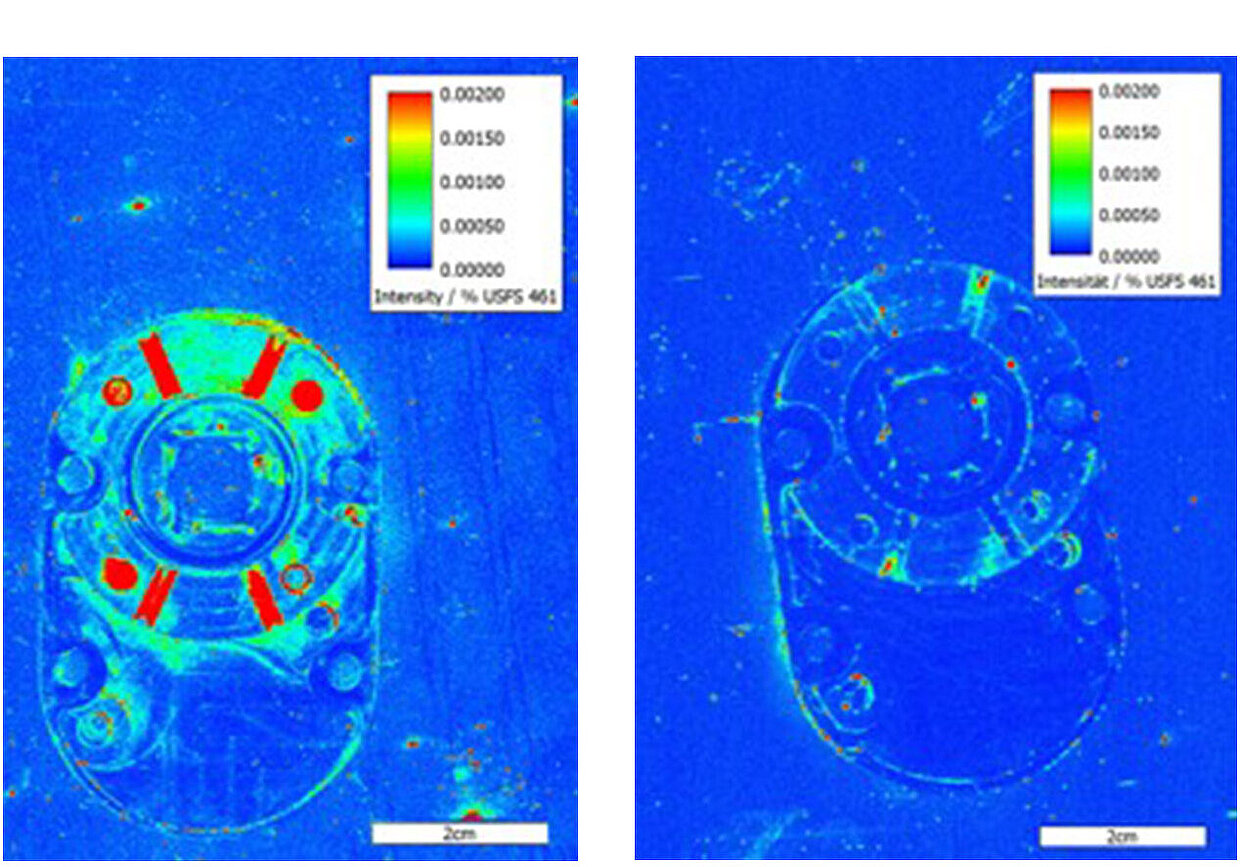
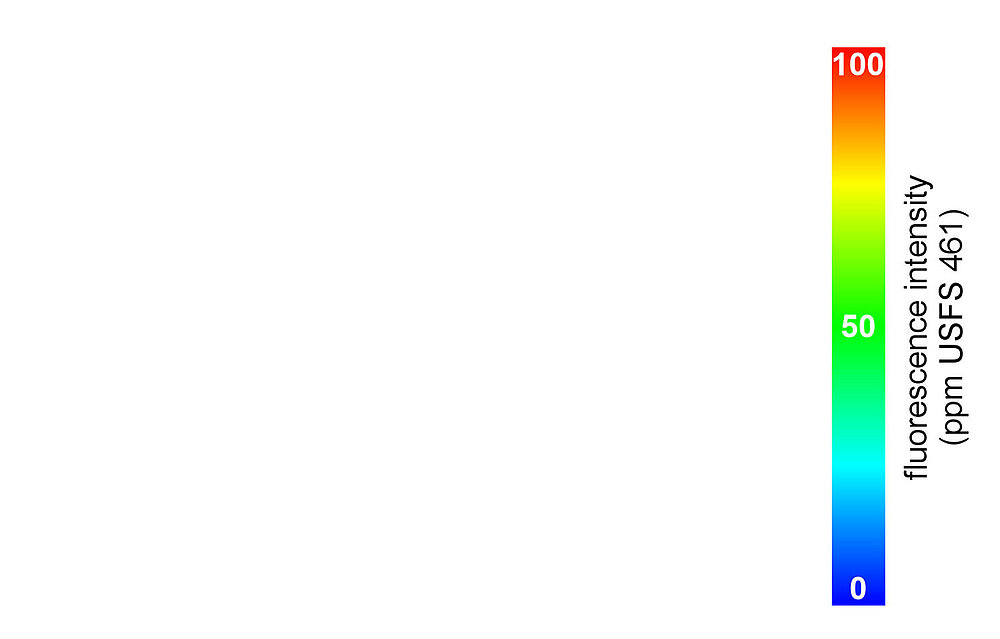
Images on the left: Filmic residues shown in red using a fluorescence measurement method. Before (1) and after (2) the pre-cleaning of a component.
This is exactly where the F-Scan fluorescence method, developed by Fraunhofer IPM, comes into play. It makes even the smallest film residues visible not only at reference points but across the entire component surface. This allows not only for an objective assessment of component cleanliness and suppliers but also, for the first time, for a comparison of the performance of different chamber cleaning systems.
Benchmark under identical conditions
What role does machine architecture play? To answer this question, Andreas Neumann, Senior Expert for Technical Cleanliness at ZEISS, initiated a cross-manufacturer comparison. The goal was to determine which cleaning system delivers stable and reproducible cleaning results based solely on its process architecture – without individual process optimization, chemical adjustments, or fine-tuning.
Therefore, the comparison focused exclusively on the basic cleaning and drying processes of the respective chamber cleaning systems.
For the comparison, all participating renowned manufacturers – including MAFAC – were provided with five identical original components with the same degree of soiling. The test conditions were also largely identical: the type and concentration of the cleaning chemicals, a water-based process involving spraying and rinsing, and the process times for cleaning and drying.
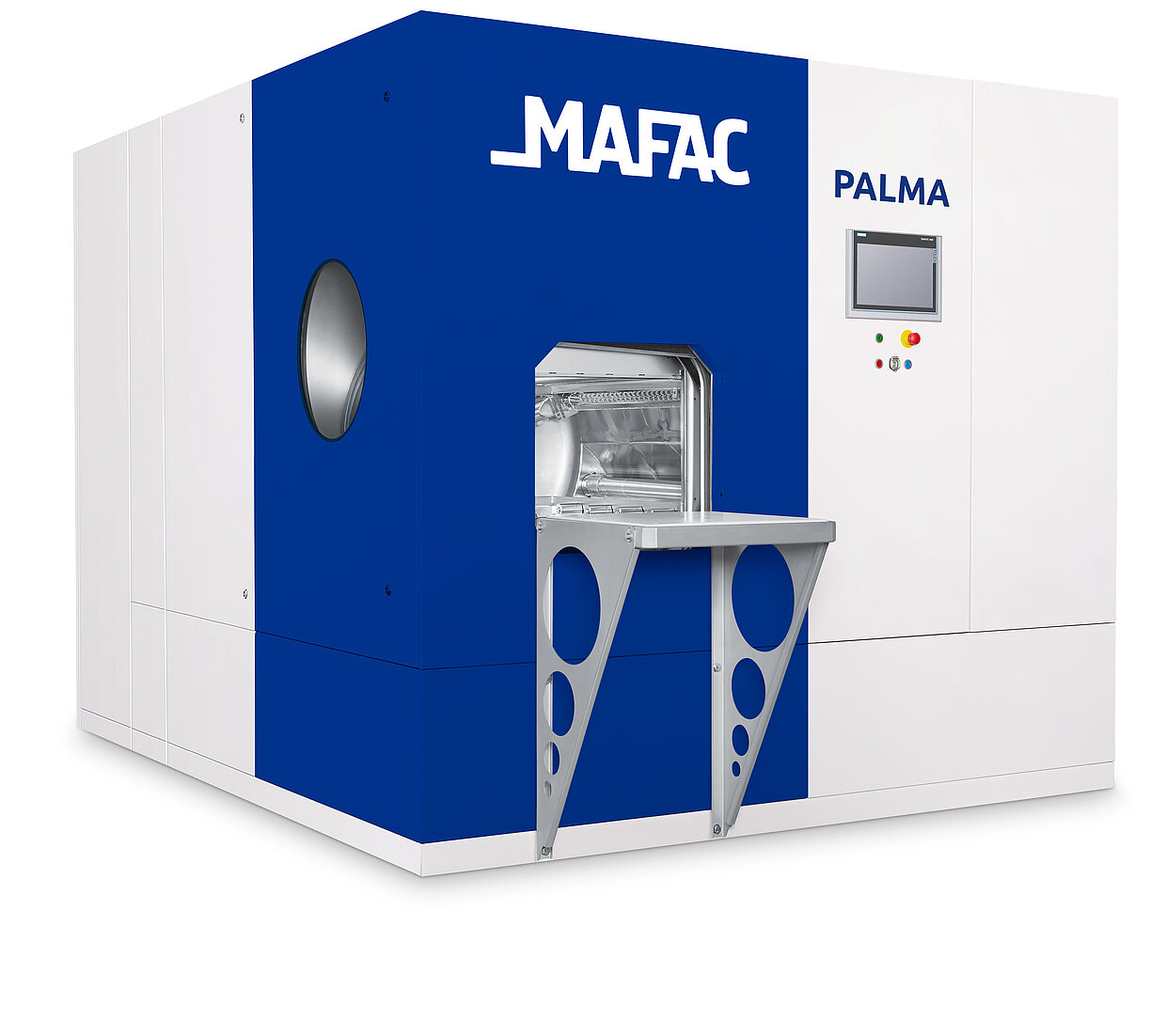
At MAFAC, the test series was conducted at the Customer Center using a MAFAC PALMA. The chamber cleaning system is designed for high-purity applications that meet the highest industry standards. Typical areas of application include the optical, precision, and medical technology sectors, as well as the semiconductor industry.
"We wanted to understand how far the technology can go on its own – even before process optimization, chemical adjustments, or parameter fine-tuning take effect."
Andreas Neumann, Senior Expert in Technical Cleanliness at ZEISS
Process architecture makes all the difference
After the test series was completed, the components were packaged to prevent recontamination and returned to ZEISS for central evaluation. There, they were analyzed using the F-Scan fluorescence measurement method developed by Fraunhofer IPM. The result: Despite largely identical test conditions across all participating machine manufacturers, measurable differences became apparent – both in the extent and in the distribution of the filmic residues on the component surfaces.
The MAFAC Principle: Intelligent Motion and Pressure Dynamics
At MAFAC, the design of the cleaning system itself lays the foundation for the cleaning performance demonstrated in the benchmark. From system design and media flow to motion and pressure dynamics, all process-relevant factors are consistently geared toward removing contaminants as completely and uniformly as possible.
MAFAC applies this principle across its entire product portfolio – from simple spray cleaning systems to multi-bath systems for high-purity applications. The goal of every cleaning solution: reproducible technical cleanliness.
A key element is the patented MAFAC kinematic system. The cleaning basket and spray system rotate synchronously and are controlled by the process. The cleaning medium strikes the workpieces from varying directions with consistent intensity. The resulting flow turbulence reliably dislodges contaminants even from complex workpieces. At the same time, the motion improves heat and mass transfer and shortens the drying process.
The patented MAFAC vector kinematics takes this principle a step further. In addition to the rotation of the basket holder and the spray system, the spray nozzles swivel outward. This results in more targeted and uniform spray application. Tests with defined contaminants impressively confirmed the cleaning effectiveness. The F-Scan revealed intensity values of just 0.002% – minimal filmic residues that are barely visible even under UV light.
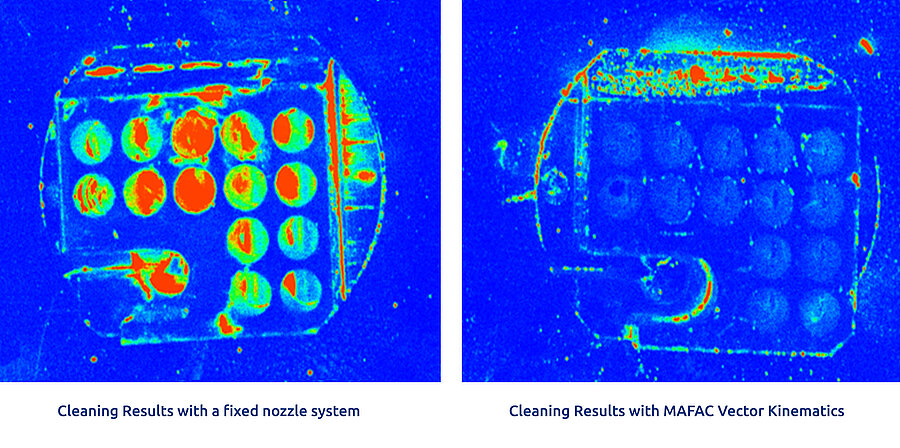
Images above: F-Scan evidence of improved cleaning performance through motion.
On the left, fixed nozzles; on the right, MAFAC vector kinematics with swiveling nozzle movement.
"We continuously adjust the angle of impact. This creates stronger flow turbulence. Even hard-to-reach areas, such as deep boreholes, can be reached during spray cleaning."
Stefan Schaal, Managing Director of MAFAC
From Benchmark to High-Purity Applications
The next logical step: to further develop the MAFAC MALTA process architecture specifically for high-purity applications at ZEISS. This is because even high-performance injection and flooding processes reach their physical limits when dealing with complex components featuring deep bores, long channels, or extremely fine internal geometries.
To achieve this, MAFAC integrated its patented pressure-switching process, VAP (Vacuum Activated Purification). By selectively alternating between vacuum and atmospheric pressure, the cleaning medium reliably reaches areas that are difficult or impossible to access using spray cleaning alone. Ultrasound was also employed. Cavitation facilitates particularly gentle yet effective cleaning of the finest structures and capillaries.
F-Scan instead of 10,000,000 point measurements
Learn more here about the process developed by Fraunhofer IPM.
Read this article