White Haze: an invisible issue with a major impact
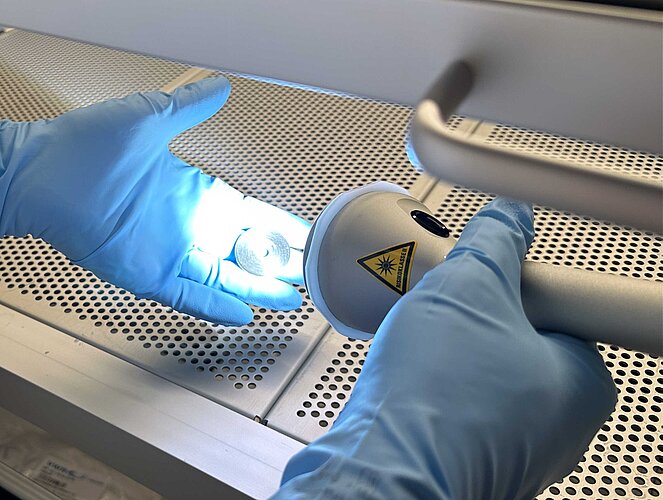
White Haze is a fine, whitish-milky film on precision metal components that often becomes visible only after machining and cleaning. A characteristic feature is that it often becomes clearly visible only under raking light (“bright light”) and, in some cases, can also be detected under UV light due to luminescence effects. It lies as a film-like coating on the surface and is often the result of complex interactions between process chemistry, material, and cleaning and drying conditions.
White haze is not specified. This makes the phenomenon all the more serious, as it leads to the rejection of the affected parts. It is precisely this lack of clear classification that makes the phenomenon challenging for suppliers—technically known, but not clearly addressed in terms of process.
"In practice, we often find that suppliers do everything right, yet issues still arise. White Haze is a perfect example of this. The key is to offer solutions that are easy for customers to understand and that integrate seamlessly into existing processes."
Michael Onken, SAFECHEM
White Haze from the Perspective of OEM Processes
Companies such as Thermo Fisher always evaluate surface conditions in the context of their potential impact on downstream processes. The focus is less on visibility per se and more on potential interactions: outgassing, chemical instability, unclear residue types, or effects under cleanroom, vacuum, or temperature conditions.
In this context, white haze is not treated as a separate category, but rather as an anomaly that requires explanation. Precisely because the phenomenon can be clearly classified as a film-like deposit, OEMs have a legitimate interest in its cause, origin, and reproducibility. What matters is not that something is visible, but why it occurs and whether this condition can be controlled.
This creates a challenging situation for suppliers. Processes that are considered stable and proven in other industries are suddenly being called into question. Not because they are fundamentally unsuitable, but because surface phenomena are emerging that fall outside the scope of traditional testing and specification criteria. White haze thus becomes a proxy for a broader question: How well is the entire process truly understood and controlled?
In practice, this leads less to formal complaints than to technical inquiries, additional analyses, or in-depth discussions. This is precisely where the pressure to act arises—not at the level of individual limit values, but at the level of process understanding, explainability, and trust.
"From a chemical standpoint, White Haze is not a typical residue, but rather the result of chemical interactions on the surface. That is precisely why simply intensifying the cleaning process is not enough. You have to understand what you're dealing with—and target the problem specifically."
Dr. Quintus Khuen
Why Traditional Cleaning Approaches Reach Their
Limits White Haze often defies the classic categories of industrial cleaning. It is neither loose contamination nor a clearly defined film that can be reliably removed using standard parameters. This is precisely where the central challenge lies: Many cleaning processes are designed for known, clearly identifiable contaminants—but not for residues that have undergone changes near the surface. In practice, it has been shown that white haze often results from the interaction of several factors. Residues from machining, additives from cooling lubricants, and water constituents can react with one another during machining, intermediate storage, or drying. These reactions take place at the material surface, either directly on the exposed metal or on the outermost oxide or passivation layer. The result is a condition that is visually noticeable but can only be chemically removed to a limited extent.
Although the lubricant industry now offers synthetic cooling lubricants that prevent this phenomenon, these are not always universally applicable. Established cleaning chemicals reach their systemic limits in this context.
Mildly alkaline or neutral cleaners reliably remove particulate and simple film-like residues, but do not interact sufficiently with chemically bound or transformed surface components. At the same time, intensifying the cleaning process—for example, through higher concentrations, temperatures, or longer durations—can produce undesirable side effects without eliminating the underlying issue. Added to this is a procedural paradox: cleaning chemicals and processes that initially dissolve residues but do not completely remove or rinse them out in a controlled manner can actually exacerbate white haze. Dissolved substances are finely dispersed, carried away, or settle again during drying, often more homogeneously and over a wider area than before. The result is no longer a localized effect, but a uniform haze.
From the user’s perspective, this creates a difficult situation. The cleaning process is formally correct, technically sound, and well-tested—yet it still yields a result that is unacceptable in the high-end environment. White haze is thus less a sign of inadequate cleaning and more an indication that conventional cleaning approaches are insufficient for this type of surface phenomenon.
“From a cleaning technology perspective, much depends not only on dissolving the residues, but also on what happens afterward. If dissolved particles are not removed, rinsed, and dried in a controlled manner, new problems arise. This is precisely where the machinery must operate in a reproducible manner; otherwise, even the best cleaning agents will be ineffective.”
Stefan Schaal, MAFAC
The Solution: Targeted Use of
Chemicals Experience from joint applications shows that white haze can only be reliably addressed if the chemical nature of the residues themselves forms the starting point for the solution. The key is not to intensify existing cleaning parameters, but to use cleaning chemicals that specifically interact with the near-surface structures from which white haze originates.
At the heart of this is a specially formulated cleaning solution from SAFECHEM. It is designed to dissolve chemically altered residues that have already formed on the surface during processing, intermediate storage, or drying. Unlike conventional cleaners, this approach does not target loose contaminants, but rather deposits that are stabilized by additives, salts, or reaction products and elude conventional cleaning methods.
Precise process control is essential to ensure that this chemical action is reproducible and gentle on the components. This is where MAFAC’s cleaning technology comes into play. It ensures that the chemically dissolved components are removed in a controlled manner, safely discharged, and do not re-deposit on the surface. Rinsing strategy, media flow, and drying are not secondary steps but integral components of the overall process. The decisive added value stems from this clear division of roles:
SAFECHEM addresses the cause at the chemical level, while MAFAC ensures the process is implemented under stable, reproducible conditions. Only this interaction makes it possible not only to prevent white haze but also to specifically reduce it when it is already present. White haze is thus not accepted as an unavoidable side effect, but as a controllable surface phenomenon—provided that the chemistry and process are consistently coordinated.
DEFINITION White Haze According to
current understanding, white haze is often caused by polymerized reaction products derived from cooling lubricant components. Due to REACH, the lubricant industry was forced to remove boric acid from formulations, which were primarily replaced by fatty acid derivatives (“fatty sticky acids”) and amine-based corrosion inhibitors. As these dry on the component surface, they can react with one another and form stable, poorly soluble structures.
These transformed residues differ chemically from their original starting materials and exhibit increased thermal and chemical stability. For practical evaluation, it is crucial to note that despite its characteristic appearance, white haze cannot be easily classified chemically and is therefore often mistaken for lime or salt residues. The phenomenon is particularly visually pronounced on non-ferrous metals.